
1. AGPC ™ Home
  2. Parrot Articles
  3. African Grey Forum
  4. Parrots For Sale
  5. Parrot Rescue Centre
  6. AGPC ™ Blog
  7. Parrot Shop
  8. Contact Us

African Grey Parrot Centre ™ Articles

Parrot Articles > African Grey Parrot Centre ™ Articles | You are here

African Grey Parrot Centre ™ Articles

Interacting With The Amazon Parrot As A Pet

June 19th, 2010

More and more people want a parrot for their pet. But not everyone fully understands how complicated it is to have a parrot in your house, especially if it’s an Amazon parrot. You must have a lot of patience and a lot of spare time to rightly breed and socialize your new pet. And of course, you must have a very good financial condition to properly maintain an African grey parrot in good conditions.

Interacting With The Amazon Parrot As A Pet : Early training is key

First of all you must know that Amazon parrots can be very aggressive pets. They can not be compared with cats or dogs. Why is that? Because Amazon parrots have very strong personalities. For you to have an obedient pet you must control him by setting rough rules and limitations. Of course these aspects are not true when we talk about a 3-month-old Amazon because at this age they all are sweet and cute. The attitude problems will develop later when hormonal changes will appear. This will happen when the parrot is 4 or 5 years old. The hormone level changes at this age because the parrot reaches sexual maturity. Because parrots are flock animals they will consider you their flock and will become very possessive with you and his territory if you will let him. So if your pet was not well bread when he was young, you will have lot of difficulties when he has reached his sexual maturity.

If you want to discipline your pet you must be very strict with her and you must handle the bird every day. If your pet is a baby parrot you will not have any problem handling her. You just have to be very patient at the beginning and handle him very careful every day, slowly, as to allow you to touch him all over. If your parrot is afraid of you, don’t rush him. Go slowly, with patience, from where he will let you to be touched. The toes are in many cases a good place to start. One thing is for sure: he will let you to touch him when he will begin to adapt to the environment. This can take weeks. You must be very patient and not push him more than he lets you. This can be a long process. Sometimes it can take weeks until he will let you touch one toe.

When you succeed touching him every where, you must go further. If you don’t want your new pet to become a one person bird, you must present him to every person in your family or friends and encourage every one to slowly touch him. In this way he will integrate perfectly in to your family. Also show him his new territory: the entire house, room by room. It is also recommended to let him alone a few times a day so that he gets used to being alone.

If he is your only bird pet, you will represent for him his new family or his new flock. You must become his new parent and show him how to behave, how to play with toys. Also, in the same time you must show him his place in the flock. As a baby the Amazon will slowly begin to chew you finger. At first it will be like a tingle but as he grows it will turn into full bites. So my advise to you is not to encourage him to bite your finger by telling him”No bite”. Do not expect your Amazon to react immediately to your request. Do not forget the Amazons are very stubborn birds. You must be very convincing and very patient in the same time.

Interacting With The Amazon Parrot As A Pet : Avoiding being bitten

An Amazon parrot should also be stick trained because they have a very powerful personality and he is very hard to handle especially if is a mature parrot and is during the breeding season. In this way you will avoid some very bloody bites on your hand and arm.

You must show your Amazon parrot his place into the flock. Do not encourage him to dominate you. For example do not encourage him to climb on to your shoulder. If you will do this, your parrot will think that that is his territory and he will protect it from any person will try to approach. Also if you will want to get him off your shoulder, he will respond aggressively and even bite you from your shoulder or even worse from your eyes. So be very careful and show him who has the controls.


About the Author

Written by Paula Dansie of the African Grey Parrot Centre ™

This article may be duplicated in its full state but the above link must be retained, if this article is found duplicated anywhere on the web without the link preserved then legal action will be taken and your ISP will be contacted.
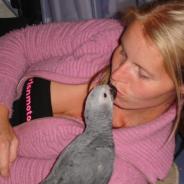

Training Your African Grey Parrot

June 19th, 2010

Discover How To Stop Your Parrot From Biting You >>>>

Training your grey African parrot requires patience, understanding, knowledge, and a lot of discipline.

As with any animal (or human being), if you teach something today and consider your job done, you’ll find that whatever behavior you were attempting to teach will be forgotten much quicker than it took you to teach it.

Consistency and discipline are of paramount importance when training a grey African parrot.

The African Grey Parrot is a medium-sized parrot of the genus Psittacus, and is native to Africa, as the name states. Also as the name states, they are predominantly grey, and have some white accents under their wings, around the eyes, and on their torso.

Some of their feathers are very dark grey, while others are of a lighter grey color. Their tail has a very contrasting red or maroon tails depending on the subspecies.

There are two subspecies, the Congo African Grey parrot and the Timneh African Grey parrot.

Training Your African Grey Parrot : Intelligent Species

The african grey parrot may be counted as one of the most intelligent of birds, therefore training grey African parrot is much easier (for the most part) than training another species of bird.

The difficulties the arise in training a grey African parrot will mostly be subject to the interactions you develop with an intelligent bird that may not always want to do what you want him to do.

The phrase “repeats everything like a parrot” or when referring to someone who mimics it is said that they are “parroting”, is not as fitting when it comes to the African grey as it is with other parrots. The African grey is not only great at mimicking, but is known and esteemed for its cognitive abilities as well.

Research and observation of the African grey parrot has led to the conclusion that these parrots are capable of associating human words with their meanings, at least to some extent.

Some birds have been known to form and speak in sentences and not just use isolated words. Although these attributes have been given to a small number of African grey’s under observation, it is a fact tat this bird is among the elite in speaking birds.

Speaking is not the only thing you can teach when training your African grey parrot. In fact, because the African grey is well known for its speaking abilities, there is much disappointment when a person happens upon a quiet African grey.

Getting upset with the breeder will lead the person nowhere, because getting a quiet or very vocal African grey parrot is like trying to get a child with certain characteristics – designing the ideal animal or child is not an exact science.

In training a grey African parrot there are a few key points that should be kept in mind in order to maximize your chances for success. They are:

Training Your African Grey Parrot : Simple Steps To Remember

Never teach something you know they don’t want to learn

  • Try to understand your bird and read into their body language – work with them!
  • Reward good behavior
  • Find a reward in the form of a treat, but don’t forget to praise!
  • Take baby steps in training and reward in small doses to encourage learning
  • Be consistent and repeat training to reinforce

And remember, a well behaved parrot will bring much happiness for both you and your bird, for many, many years.


About the Author

From Alyson Burgess


How to Correct Badly Behaved Birds

June 19th, 2010

Discover How To Stop Your Parrot From Biting You >>>>

Gentle and Effective Training Tips

When asked why she believes that birds are descended from dinosaurs, an acquaintance of mine who owns a Scarlet Macaw will readily reply: “Would you like to see the scar on my arm?”

Beliefs about the origins of birds aside, most can agree that some parts of a bird’s anatomy can deliver quite painful attacks if our pets become angry with us. Indeed, the instincts and inherently wild nature of our avian companions can bring forth many behaviors that are undesirable in the home. Dealing with these issues can be especially trying for bird owners, given that their feathered friends are such highly sociable and emotionally sensitive creatures. Read on for tips that will help you gently but effectively convey your displeasure toward undesirable behavior in your pet bird.

  • The Rules of Avian Discipline Although at times your pet may behave in a way that annoys you or makes you downright mad, it’s important to remember these rules when responding to the transgression:

  • Never hit a bird. Birds are extremely fragile creatures and even the slightest force can cause severe injury or death. Physically abusing a bird can also lead to irreversible psychological problems, and can promote aggression and viciousness.

  • Don’t hold a grudge. Birds are extremely intelligent, but also very sensitive creatures. When you express displeasure with your bird’s behavior, make the lesson short and sweet. Prolonged negative attention can cause undue emotional stress for your pet.

  • Never compromise your bird’s health. “Punishing” a bird by witholding food or neglecting cage cleaning is never a fit way to deal with a behavior problem. Such actions are not only cruel, but can cause serious physical and emotional damage for the pet.

How to Correct Badly Behaved Birds : Responding to Bad Behaviour

In order for your bird to understand you when you catch him acting up, it’s necessary that you remember the correct way to respond. While a normal “human” response to an unpleasant discovery would be to loudly declare your grievance, a bird can interpret this reaction and body language as excitement — meaning that he may actually think you are praising the behavior. Conclusively, dealing with a bird’s behavior problem can be just as much about training yourself as it is about training your pet.

In order to respond properly to undesirable behavior, it’s helpful to keep the following steps in mind. With consistency and patience, you may find that it won’t take long for your bird to catch on.

  • Have the bird step up onto your hand. When your bird misbehaves, have him step up onto your hand and hold him at eye level.

  • Be very expressive. Don’t be afraid to frown at your bird. Avians are capable of picking up on facial expressions, and most get the idea if your body language expresses your distaste for his actions.

  • Speak softly, but sternly. Use a tone of voice that is low but not loud when you tell your bird that he has done wrong. Be as “matter of fact” as possible, but keep it short. You will be amazed at how effective it can be!

  • Place your bird on his cage or perch. After you’ve conveyed your dissatisfaction, have your bird step off of your hand and onto his cage or perch. Allow him to stay there for a few minutes to reflect on what happened, and then go back and interact playfully with your pet — he should know that you are no longer upset with him, and that he is now being a good bird.

How to Correct Badly Behaved Birds : Consistency is Key

All birds are individuals, and some may catch on quicker than others. Don’t get discouraged if your pet’s behavior doesn’t change overnight. As long as you stay consistent with your training methods, your bird will likely understand you sooner rather than later.

Remember that positively reinforcing good behavior is just as important than pointing out and modifying bad behavior. If you notice your bird acting exceptionally well, don’t miss the chance to lavish praise on your pet. Birds respond much more readily to training techniques that focus on the positive rather than the negative, so don’t forget to incorporate lots of fun and praise into your training methods.

With a little work, patience, and love, your bird should be acting like an angel in no time. Your effort will be rewarded with a beautiful, intelligent, and well-behaved pet — and who could ask for anything more?


About the Author

From Alyson Burgess


Parrot Stopped Talking?

June 19th, 2010

Parrot Stopped Talking

Why parrots stop talking is not always the problem. Some people long for their parrots to stop talking, simply because they talk incessantly once they have learned a few phrases. Parrots are very sociable, and want to communicate with other members of their “flock” – which means the people with whom they live. So a talking parrot is probably more common.

There are times, however, when parrots stop talking, and then the worried owner wants to know why parrots stop talking.

Reasons Why Parrots Stop Talking

There are several reasons why parrots stop talking. We cannot give a complete list here, but one of the following may apply to your parrot.

1. Some talking parrots stop talking for a few days when they arrive in a new home. They are adjusting to the change. They find themselves suddenly with a new “flock” in a new environment. Even a talking parrot will take time to sort things out in its mind before it feels comfortable.

2. Sometimes talking parrots stop talking when they are feeling ill. If your parrot has been talking, and stops with no apparent reason, consider health issues. You may need to take it to an avian veterinarian.

3. Talking parrots will “pout” and stop talking when they are unhappy with a change you have made. It may be you have moved the furniture in the room where the parrot spends most of its time. Maybe you are wearing an article of clothing the parrot does not like.

4. Another reason talking parrots may stop talking is the introduction of a new family member, either human or another pet. The parrot must work through the change, and stops talking while adjusting.

5. Sometimes a talking parrot has been frightened, perhaps by a prey animal. The animal may be outside, but visible from the parrot’s cage.

6. Finally, a talking parrot may stop talking if it becomes bored with its own chatter, and hears few words from you. Remember that your parrot talks to communicate with you. It is in a “foreign” land, away from those that speak its language, and is trying to learn your language to communicate.

What to Do When Parrots Stop Talking

There are several things you can do to encourage a talking parrot that has stopped talking.

If your talking parrot is in new surroundings, make it as comfortable as possible. Give it time to adjust, but while it’s adjusting, talk to it gently and frequently. As soon as it decides the new surroundings are safe, it will probably begin talking again.

If you suspect your talking parrot’s sudden silence is an early sign of illness, look at its eyes and feathers. If you detect dullness in either, you may need to have an avian (bird) veterinarian check your parrot.

Sometimes the answer is as simple as finding a change you have made in the previous few days or week. Did you move a vase that used to reflect the light? Did you move the parrot’s cage a few feet one way or another? Try to remember what may have changed and put it back the way it was. Your talking parrot may quickly speak up to thank you.

Check for predators, even though you know they cannot reach the parrot. A large, predatory bird flying past the window, or sitting in a tree outside can be the reason a talking parrot stops talking.

The best solution to helping a talking parrot find its tongue is to spend more time talking to and around the bird. Take it into other rooms with you and the family so it will feel like being a part of the conversation.

Talk to your bird as much as you would talk to a family member or very good friend, and before long, it should begin talking again.


About the Author

Anna Hart. An avid reader and researcher, Anna explores many parrot species, and offers other interesting parrot information at www.parrots-of-the-world.com If you would like to learn more about how to train your parrot, you won’t want to miss Anna’s advice.


Choosing Safe Parrot Toys

June 19th, 2010

You are the proud owner of a parrot and you are looking for a toy for your pet. The offer of parrot toys on the market is huge, so how do you know which parrot toy is safe for your pet? Because you should be aware that some of them are dangerous for pets as they may hurt them. Therefore, an important parrot care issue is its toys.

The first aspect you should take into consideration when buying a parrot toy is the size of the toy and the size of the pet. Basically the parrot toy should fit the size of your parrot. Why is that? Well, because a big size parrot is strong and can easily break a small toy into pieces which can be easily ingested by your pet. Therefore, try to avoid small parrot toys if your pet is big. You should know that nowadays there is a large array of big parrot toys which are made from thick plastic, perfect for a big strong-beaked parrot.

Things aren’t easy with small parrots wither. A small size parrot can be afraid of a big toy so try to fit the size of the toy to the one of the pet. If you can’t tell which parrot toy is good for your pet, look at the label or ask for more information.

Another important aspect is the type of the parrot toy. You should avoid buying parrot toys which are made out of small pieces as the parrot can remove them and, consequently digest them. Remember that a parrot has a strong beak therefore any piece which is bite-size for the parrot should not be on the toy.

A parrot toy is usually hanging on some chains. These chains can represent a possible danger for the health or life of your pet. How is this possible? Well, chains come in two types: the chains with welded links (which are safe for your parrot) and the chains with closed links (which are not safe). The parrot may try to open up the link which is not weld and its beak would get stuck in that space. The parrot may get hurt while trying to release itself. Consequently, examine carefully the chains attached to your parrot toys.

But the chains are not the only dangerous pieces of a parrot toy. Parrot toys made out of wood may also be dangerous. Therefore, wood is another important aspect to think of. Parrots are birds which love to chew wood. They do this to find bugs hidden inside the tree bark in the woods. So a parrot will always start chewing a toy made out of wood. Some types of wood are not good for parrots, so you should check the internet for a list of parrot-safe wood.

Parrots are also birds which enjoy preening and grooming. Their instinct is telling them to constantly pick or even chew their feathers. This is not a healthy habit for your pet. So you should buy a chew rope, which is a very useful parrot toy as it allows your pet to exercise its habit every day without causing any problems to itself. But pay attention to the deterioration of the toy as it gets extremely ragged and worn out. Replace it with a new toy as the clumps may cause accidents to your pet. Your parrot could catch its feet into the clumps and could get hurt while struggling to escape.

In conclusion, there is only one rule to apply for this parrot care issues: whenever shopping for a parrot toy use the common sense rule. If you look at a parrot toy and it doesn’t seem safe, don’t buy it. Don’t buy any parrot toys which can get ingested or which can get a foot or a beak caught inside them. And always examine the parrot toys carefully before putting them into your pet’s cage.

And if your parrot is ignoring its new, shiny toy, don’t worry. It doesn’t hate it, it is just being cautious. Parrots don’t like change, like most pets. And a new toy represents an unexpected change for their habitat. Therefore, the toy must be put under strict observation to make sure it is not a possible enemy. After two or three weeks of monitoring the intruder (the toy) the parrot will gain confidence into its new toy and it will start playing with it!


About the Author

www.kokkada.com


Join The Forum

RSS Feeds

Parrot Articles > African Grey Parrot Centre ™ Articles | You are here