1. AGPC ™ Home
  2. Parrot Articles
  3. African Grey Forum
  4. Parrots For Sale
  5. Parrot Rescue Centre
  6. AGPC ™ Blog
  7. Parrot Shop
  8. Contact Us

admin | African Grey Parrot Centre ™ Articles - Part 8

Parrot Articles > admin | African Grey Parrot Centre ™ Articles - Part 8 | You are here

admin | African Grey Parrot Centre ™ Articles - Part 8

Teaching Your Parrot To Talk

June 18th, 2010

Introduction

Talking Parrot

After reading so many request for information regarding talking, on the various mail lists I decided to write my own article on the subject. My experience deals with the two Congo African Greys in our flock and what I have learned and read on the different mail lists in the last 3 years. Both our Grey are prolific talkers and we lost count of how many words, phrases and sounds that they know a long time ago. Most of the questions related to talking are asked by the new parrot owner so this article is mainly directed towards them.

We all love parrots for many reasons but the ability to produce human speech and to mimic a variety of sounds is a big reason why parrots have fascinated mankind for so long. Amongst the many reasons for choosing a particular species of parrot as a companion, intelligence and talking ability are often placed very high on the priority list. Every parrot owner I have ever met is thrilled when the first word is spoken.

Training

New parrot owners often ask, “What methods should I use to teach my parrot how to talk?”

Interaction is the key! Parrots are flock orientated and learn to interact with other members of the flock by making the same sounds and gestures as the other flock members. Use the same methods you would with a small child. When you walk into the room say “Hello Bird”, when feeding “Do you want some birdie dinner?” when covering the cage at night “Night Night Bird”. Huey, our 3 year old CAG said his first word “Tickle Tickle” at 14 months old. “Tickle”, is a game we played when he was in his cage and I would tickle his feet or tummy through the bars (interaction). Even your gestures will be imitated in time. When our CAGS sing they often bounce up and down imitating the movement made when singing or dancing. Huey will say “Up down, left right, one two” from watching us exercising. He stands tall when saying “up”, crouches for “down” and moves his head side to side for “left right”.

In my opinion, tapes or recordings commonly advertised as methods to teach parrots to talk are of little or no value. Parrots learn through interaction and a desire to participate like other flock members. Voice tapes do not offer the stimulation needed. Music is a different story and by its very nature can be stimulating. Both or CAGs like to sing and dance to music, “Pop Goes The Weasel” is the present favorite.

When will my parrot start talking? He is 10 months old and does not talk yet, what should I do?

There is no set rule to determine when your parrot will say his first words and it varies a great deal. In general, African Greys often begin to talk some time after 12 months of age. As I mentioned earlier, Huey did not start until 14 months old, he has not sopped since.

In summation, teach your parrot like a young child, repeating words slowly and enunciating clearly and above all interact.

Roy Berger


About the Author

This article was written by Roy Berger

Foraging Toys

May 2nd, 2010

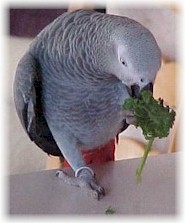
Zachie The Grey  Eating Greens

Diet plays a major role in a parrot’s life. Diet promotes good behavior, health and longevity! Here are some fun food toys to offer your bird which may even tempt the finicky birds who need to be on the road to better health!

Foraging Toys: Pouch Surprise

Take a washed, large leafy green (i.e. Kale, Mustard Greens, Beet Greens) and take some leftover Brown Rice (brown rice is more nutritional than white rice) and pour it into the center of the leaf. You can add some Cranberries, Sprouts, Raisins, or Blueberries. Try not to over fill the leaf. Grab all the ends of the leaf and tie them together to form a pouch. If you would prefer to make a veggie or fruit mash: Take some of their favorites and throw them in the food processor and use that in your Pouch Surprise! Use something that you know they love and can smell. Some birds like a whiff of cinnamon or the smell of parsley. Our flock seems to enjoy fresh garlic. Take about a foot of 100% Natural Cotton Rope and tie a knot and make a loop at the end to affix it in the inside of your bird’s cage. Vegetable tanned leather strips can also be used to string up the Pouch Surprise. Note: Keep the rope very trim so your bird cannot get caught in the dangling rope strands and knotted tightly. They will be very curious of this new fun and healthy toy you placed in there and will rip apart the leaf and find the little surprises you have tucked within.

Foraging Toys: Weaving

If you are having trouble getting your bird to try some of those high vitamin items you desperately want them to eat. Try taking them and weaving them through the bars of your bird’s cage. Start with a small leaf if your bird is afraid of new items within their cage domain. Perhaps washed Carrot Tops, Beet or Dandelion Greens would be a wonderful place to start.. Remember to be enthusiastic about these items. Parrots are very curious by instinct and will wonder what “all the fuss” is about. Before you know it, he will be ripping apart the leaves. The first step on the road to better eating is forming a taste for it. By ripping apart the leaves, your bird will be ingesting some of the nutrients. My flock loves to rub their feathers on the freshly washed leaves then tear it to shreds! You will see your bird will enjoy eating the stems of the leafy greens which is where most of the nutrients are!

Foraging Toys: Pick-Up Stix

I remember playing Pick-Up Stix as a youngster. Well this fun foraging game can be just as much fun for your avian companion!

Take some carrots, kohlrabi, beets – whatever you can find and cut them into long sticks. (Maybe 1/2 the size of a Chop Stick in length.) Here is where the fun begins. Just you and your avian companion at the kitchen table or counter. My flock loves to be on the counter and play with food items. Note: Remove all objects from the area so that nothing is around to “distract” those curious beaks. This will keep them focused. (for a moment or two at least). Start placing the “veggie stix” out and making a pile out of them. Watch your bird come over and pick up the sticks along with you. He may throw them off the counter – be warned! Put some newspaper down to catch whatever may go falling down.

Our greatest challenge as parents to these wonderful feathered creatures is constantly finding new and exciting way to keep them interested and intrigued. No doubt you will come up with your own ideas for your and your pet bird.

Note: There are many foraging toys on the market today which help to hide treats and make life more interesting for you and your avian companion. Feel free to visit Grey Feather Toy Creations to see our new line of Stainless Steel Foraging Toys.

About the Author

This article was written by It’s a Grey’s World


Feather Plucking And African Greys

May 2nd, 2010

Plucked African Grey

Feather plucking is known to be a very nasty habit of the african grey parrot. They are notorious feather pluckers. It is said that the Timneh African Grey parrots are not as bad as the Congo African Grey Parrots when it comes to feather plucking. But this is not a proven fact.

First of all any parrot keeper should ask himself why do parrots pluck their feathers. There are many different reasons for this nasty habit. The African grey parrot is a parrot species that need quite much attention from his human owner. If this doesn’t happens then the bird will probably get bored and this can result to feather plucking. But belive me that the this feather plucking problem is very complicated because it’s very hard to resolve it. There were cases when the african greys plucked their feathers because of getting to much attention. So you just don’t know exactly how to treat your bird. Dietary imbalances, or environmental problems may also take to feather plucking. Some environmental problems could be smocking very much in the room where the parrot is kept or keeping him in a space with dry air. Also is recommended for african grey parrots to get regular baths or to be exposed to some kind of moist air. The african grey parrots shouldn’t encounter any frightening experiences because this can take to feather plucking.

If this nasty habit appears in you bird’s daily activities than you should first see a veterinarian. He will probably try to find a physical explanation for the bird’s problem. It’s best to try to understand what the veterinarian explains and try to find some ways of resolving the problem. It is proven that the african grey parrot is the most intelligent species. His higher degree of intelligence, along with possible incorrect early socialization at the breeders and not understanding the bird?s intellectual needs when it becomes a companion parrot often leads to neurotic habits — such as plucking.

Timnehs african grey parrots don’t pluck their feathers as much as the congo african grey parrot. This could be because they were not as popular as the congo african parrot. Because of their duller coloration they weren’t as licked as the congo.

In conclusion the feather plucking is a major problem for the african grey parrots because they are very difficult birds to take care of.


Join The Forum

RSS Feeds

Parrot Articles > admin | African Grey Parrot Centre ™ Articles - Part 8 | You are here